
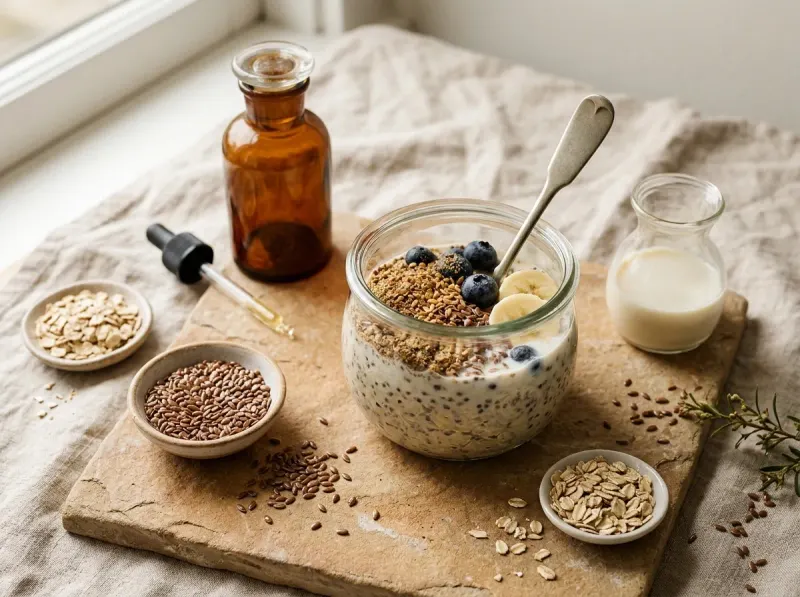
Direct Answer: Adding 1 to 2 tablespoons of freshly ground flaxseed to overnight oats turns a carb-heavy breakfast into a slow-release metabolic meal. Grinding cracks the hard seed coat so your gut can absorb omega-3 ALA and lignans, while overnight cold soaking hydrates mucilage fiber to buffer morning glucose spikes.
Overnight oats look healthy on paper, yet many people feel hungry again by 10:00 AM—or watch their continuous glucose monitor (CGM) climb sharply after eating a plain jar of oats and milk. The missing piece is rarely willpower; it is meal architecture.
Tossing a spoonful of flaxseed into your mason jar fixes two problems at once: texture and glycemic speed. Still, there is a critical difference between dumping in whole seeds versus freshly milled flax, and getting the liquid ratio right determines whether your breakfast turns out creamy or chalky.
Whole vs. Ground: The Seed Coat Bioavailability Rule
Whole flaxseeds are protected by an extraordinarily tough, cellulose-rich outer hull designed to survive intact through the digestive tracts of birds and animals. In practical terms, if you stir whole flaxseeds into overnight oats and do not chew every single seed thoroughly, most of them pass straight into the toilet untouched.
Cracking or milling flaxseed breaks open that seed shell and unlocks three distinct functional compounds:
- Secoisolariciresinol Diglucoside (SDG) Lignans: Flax is the richest known dietary source of plant lignans (up to 75 to 800 times higher than most grains and vegetables). Gut bacteria convert SDG into mammalian lignans—enterodiol and enterolactone—which exhibit mild antioxidant, hormone-modulating, and cardiometabolic protective activity in human observational and intervention studies.
- Alpha-Linolenic Acid (ALA): A plant-based omega-3 polyunsaturated fatty acid. While human conversion of ALA to long-chain EPA and DHA is modest (typically under 5% to 10%), higher dietary ALA intake consistently correlates with lower inflammatory markers (
CRP,IL-6) and healthier lipid profiles. - Mucilage Gums (Arabinoxylans and Rhamnogalacturonans): Roughly 35% to 45% of flaxseed fiber is water-soluble mucilage. Unlike hot cooking, cold overnight soaking gently hydrates these hydrocolloids into a dense, viscous gel without damaging delicate polyunsaturated fats.
Whole vs. Ground Flaxseed vs. Flaxseed Oil in Overnight Oats
| Flaxseed Form | ALA Omega-3 Uptake | Lignan & Mucilage Access | Gelation & Texture Effect | Best Breakfast Use |
|---|---|---|---|---|
| Ground / Milled Flaxseed | High (oil droplets exposed) | High (full hull fracture) | Strong viscous thickening; creamy pudding texture | Ideal default for overnight oats (1–2 tbsp) |
| Whole Flaxseed | Low (unless chewed thoroughly) | Low (passes mostly intact) | Minimal internal gel release | Better as a crunchy garnish only |
| Cold-Pressed Flaxseed Oil | Very high | Near zero (lignans and fiber removed) | No thickening; glossy mouthfeel | Drizzle post-prep if extra omega-3s are desired |
How Flax Mucilage and Oat Beta-Glucan Flatten Glucose Curves
According to clinical research on viscous fibers, pairing flax mucilage with oat beta-glucan creates a double-layered mesh inside the stomach and proximal duodenum. That hydrated matrix increases chyme viscosity, slows gastric emptying, and physically hinders pancreatic alpha-amylase from rapidly hydrolyzing oat starch into free glucose.
Overnight cold soaking adds another subtle advantage: keeping rolled or steel-cut oats unheated preserves more intact starch crystal structure and slightly higher resistant starch than mushy instant microwaved porridge. Adding ground flaxseed supplies roughly 2 grams of healthy fat and 2 grams of protein per tablespoon, further stimulating satiety hormones such as cholecystokinin (CCK) and peptide YY (PYY).
The Exact Liquid Ratio and Freshness Protocol
Because ground flaxseed absorbs roughly four to five times its weight in water, tossing it into a standard 1:1 oats-to-milk recipe creates a concrete-like paste by morning. Follow this reliable formula for a busy weekday morning:
- Base: 1/2 cup (40g) old-fashioned rolled oats or steel-cut oats (avoid instant packets)
- Flax dose: 1 to 2 tablespoons (7–14g) ground golden or brown flaxseed
- Protein anchor: 1/2 cup plain unsweetened Greek yogurt or skyr (adds ~12–15g protein to keep total meal protein above 20–25g)
- Liquid: 3/4 cup unsweetened soy milk, almond milk, or dairy milk (increase to 7/8 cup if using a full 2 tablespoons of flax)
- Polyphenol & mineral finish: 1/4 teaspoon Ceylon cinnamon and a pinch of sea salt, topped in the morning with thawed wild berries or chopped walnuts
Storage rule for nutrient integrity: Exposed ALA fatty acids oxidize quickly when exposed to light, heat, and oxygen. Buy whole flaxseeds in bulk and grind a week’s supply in a clean coffee grinder, or store pre-ground flaxseed in an opaque, airtight container inside your refrigerator or freezer for up to 3 to 4 months. Discard any bag that smells faintly like oil paint or varnish—that odor signals lipid rancidity.
Looking for more blood-sugar-friendly meal prep combinations? Explore our recipe archive or download The Everyday Superfood Index for portion targets across nuts, seeds, and functional grains.
Frequently Asked Questions
How much ground flaxseed should I put in overnight oats?
Start with 1 tablespoon (7 grams) per jar if you are new to high-mucilage fiber, then step up to 2 tablespoons (14 grams) over two weeks while drinking an extra glass of water in the morning. Two tablespoons provide roughly 3.2 grams of ALA omega-3s and 4 grams of mostly soluble and insoluble fiber.
Golden vs. brown flaxseed: does one have better nutrition for oats?
Nutritionally, golden and brown flaxseeds are virtually identical in ALA omega-3 content, protein, and lignans, with minor seasonal differences in oil percentage. Golden flaxseed has a slightly milder, nuttier flavor and blends inconspicuously into vanilla or berry oats.
Can I add chia seeds and flaxseed together in overnight oats?
Yes. Combining 1 tablespoon ground flaxseed and 1 tablespoon chia seeds gives you both lignans and extra gelling fiber, though you will need about 1 full cup of total liquid per 1/2 cup of oats so the mixture stays spoonable.
Does soaking flaxseed overnight remove cyanogenic glycosides or antinutrients?
Flaxseed contains tiny trace amounts of cyanogenic glycosides and phytic acid that are harmless for healthy adults within normal culinary intakes of 1 to 3 tablespoons daily. Cold soaking does not destroy ALA fats and gently softens seed fibers for comfortable digestion.
Medical Disclaimer: This content is for general nutritional education and is not medical advice. Increase dietary fiber gradually and consult a clinician if you have inflammatory bowel strictures, gastroparesis, or hormone-sensitive conditions requiring tailored guidance.